
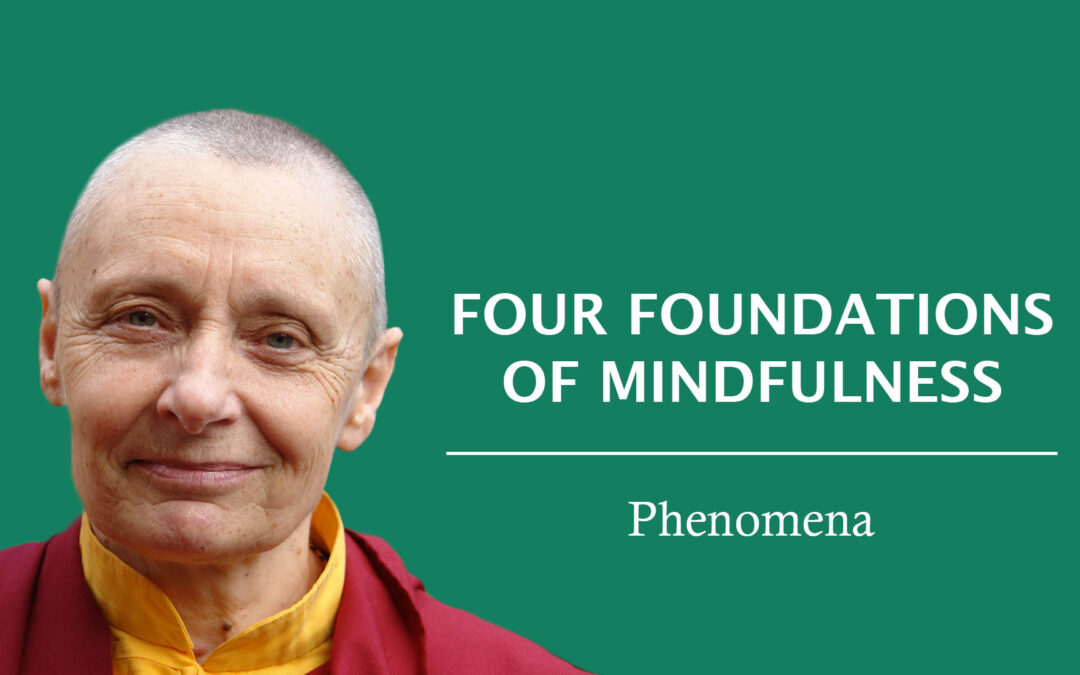
The Four Foundations of Mindfulness – Dhamma or Phenomena
Jetsunma Tenzin Palmo, USA, Santa Cruz, September 8th 2002, Tape 5.
The fourth of the levels of mindfulness is called dharma in Sanskrit, or dhamma in Pali. Now the word dharma has many meanings. In this context in the Theravadin tradition it means that as one observes the thoughts they are classified: this is one of the five poisons, one of the Seven Factors of Enlightenment, one limb of the Noble Eightfold Path. As thoughts occur they are classified according to the Abhidharma system.
However the Tibetans usually say that dharmas here mean phenomena—the external environment. In other words, first of all we became conscious of the body, we centred ourselves in the body, experiencing the body in the body. In other words we are not thinking about the body, we are actually knowing it. When we do yoga or tai chi or something like that, we become one with the body, we feel the body, we are not thinking about it, we are experiencing it. So the mind becomes centred and present.
When the mind is centred and present in the body or with the breath then one becomes conscious of the feelings, the sensation of pleasure or discomfort or neutral. So that what we see, hear, taste, touch and what we think about, each one carries a tone of pleasure or displeasure or neutral. So that is the mindfulness of the sensation. Watch and observe how true that is. Everything we experience has a quality along with it: we like it, we don’t like it or we feel indifferent. And it is all changing moment to moment.
Then we observe the thoughts and see how those sensations which are pleasurable invite us to reach out and grasp, while those which are unpleasant we avoid and push away. So we learn how to develop that sense letting go. We let go of the negativities in the mind such as the grasping mind, the greedy mind, the angry mind, the mind of aversion or resentment, the mind of envy, of competition, the mind which is endlessly revolving around me, me, me, me. So we learn to recognise all those, to accept that is what is happening and practise letting go. In addition we recognise the good qualities, such as the kindness in the heart, loving kindness, thoughtfulness, generosity, the pleasure in our Dharma life, the thoughts about others beyond ourselves. The practice is to recognise all the good qualities of the heart and encourage them.
So that leads to becoming more conscious of everything going on around us and this more panoramic vision is considered the fourth aspect of mindfulness, dharmas, here in the sense of phenomena. Everything that we see, hear, taste, touch and experience in our mind are called “dharmas”. We contact our seeming external reality through the sense doors and then that sensory input is interpreted by the mind. The whole time we are constantly interacting with what is outside of ourselves. So therefore, these qualities of mind—positive and negative—are interacting with the sense-stimuli which is streaming in, and these are interpreted by the mind.
First there is the sensation. We have form and therefore we have the sense organs, our eyes, our ears, nose, taste, touch, feel and we have the sense-consciousnesses. Because even if we had eyes but we have no eye-consciousness then we would be blind. The external phenomena impinges on the sense organ and is received as a sensation. That is then interpreted by the consciousness as pleasant, unpleasant or neutral. The mind then reacts with grasping, rejection or indifference. So it all comes together—the external and the internal—and the challenge is to be aware of the process.
We don’t have to react to everything. Inwardly we can be spacious and open, like a house with all the windows and doors open and no furniture: the doors of the senses are open and the wind passes through: it’s very spacious and empty. Things are perceived and we can like them or we can dislike them, that’s not the problem: the problem is grasping at that. It’s not that we can’t appreciate something or not, but are we holding tightly to our conceptions and opinions: clinging to what we like and pushing away what we don’t like? Or can we allow everything to flow so that whatever happens we are open. Then there is nothing solid to hit against: just empty, open spaciousness. If we have no buttons then nobody can push them. Whatever comes up, comes up and flows on. This is actually what is happening anyway except that we want to solidify things and make them stay the way they are and we don’t understand that nothing stays, everything is flowing—externally and internally—moment to moment to moment. Essentially there is no one at home.
We are not the way we appear to ourselves to be. It is our delusion that causes the problem, not the outside environment, nor other people. We tend to put the blame outside of ourselves. However there is no need to put the blame anywhere, not even on ourselves. Rather we should feel compassion for our own delusion. When we understand the extent of our own confusion then we can see so clearly the extent of others’ delusion. Everyone wants to be happy, we expend so much time, so much effort, so much money into making ourselves happy, so how is it that most people we meet are so sad? And we make others miserable. Nobody gets up in the morning and say, “How can I make myself feel really, really awful today?”
It is due to our confusion as to where real happiness lies. We are deceived but that delusion isn’t a matter of blame; it’s a cause for compassion. We are deluded. Our families are deluded. Our neighbours are deluded. Our countries are deluded; our government is deluded, who is not deluded? That is not the cause for anger, that is the cause for compassion and for skilfully working to transform that delusion into understanding. That’s why we are meditating: to transform the confusion of the mind into wisdom and compassion.
Now the method is very simple but we have to do it—not just when we come to a Dharma centre but all through the day, with our family, with our colleagues, with our partners, with friends, with the people who are difficult: everybody, everywhere, at all times. When we are aware, every single thing we do is a practice. Otherwise nothing is going to change and the years go by, we get more wrinkles but essentially nothing changes: all the habitual patterns of response, negative or positive stay the same and it is very difficult. So we have to work like a skilful potter moulding his work. Please practise so that at the time of death you have no regrets. You can die knowing that you did something meaningful with your life. That your life had a beneficial meaning for yourself and for others. Since we don’t know when we are going to die, we have to get to work right now and live each day as if this were our very last.
***
May All Beings Benefit
Sarva Mangalam