
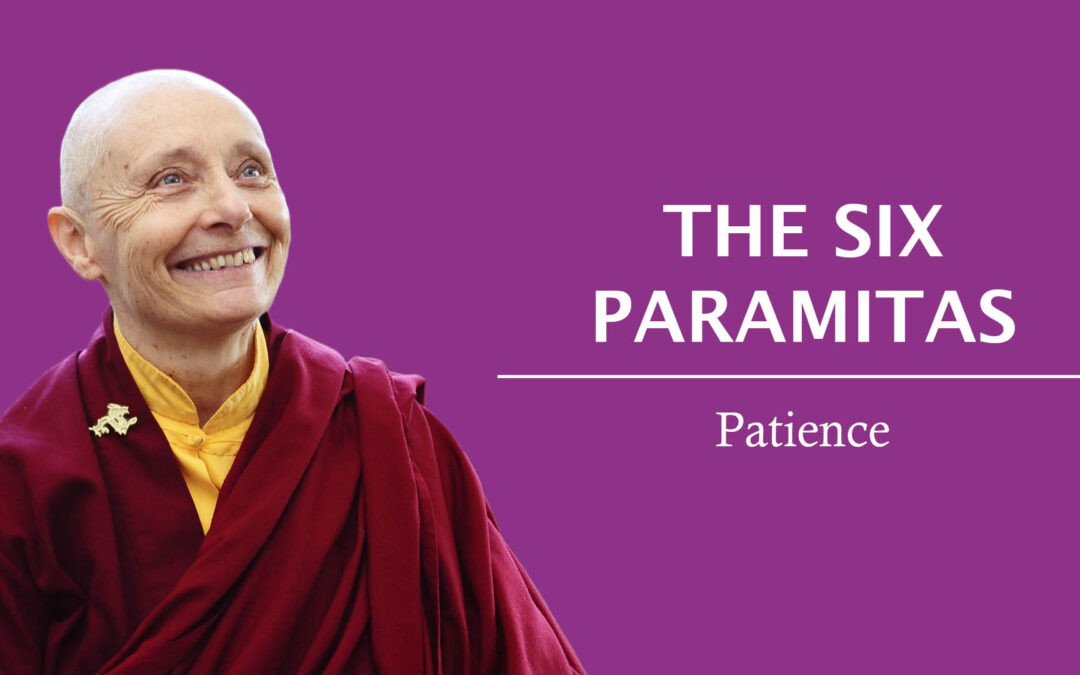
The Six Paramitas: Shanti or Patience
The next paramita is the perfection of patience or Shanti Paramita. In ancient India, as in many other spiritual traditions, there is a kind of austerity known in Sanskrit as tapasya. This often took the form of very severe fasting. For example the Buddha himself fasted until he was only eating a single grain of rice a day. Another austerity would be standing for years with one arm in the air or always standing and never sitting down or standing on one foot or standing in the Indian summer in the midst of 4 fires with the sun above as the fifth fire. These are things which people do even till today. But the Buddha said, forget about all those, the greatest “tapasya” is patience.
Now, this idea of patience means having patience and tolerance towards difficult people and towards adverse conditions and trying circumstances. It’s to have the kind of mind which is very open and spacious.
Consider, each one of us is just one person. There is one ‘me’ and then in this whole world there are billions of ‘non-me’. How is it possible that all those others are going to do everything and say everything and act exactly as how I want them to act? There are so many of them and only one of me. It’s not possible. So what should we do about that? Are we going to spend our lives trying to make everybody do and say exactly what we want them to do and say, in order that we may be peaceful? This is not feasible. The example is given by the 7th Century Indian philosopher, Shantideva, in the Bodhicharyavatara, where he said that the earth is full of stones and thorns and as we walk around, we are bound to be stubbing our toes all the time on the sharp flints. So what are we going to do to protect our feet? Are we going to carpet the whole earth? Are we going to put a carpet down over the whole world so that it will be soft on our feet? This is not possible and even Bill Gates and Rupert Murdoch combined, could not carpet the whole world. But there is no need, we don’t need to go to such extremes. All we require is a piece of leather beneath our soles in the form of sandals or shoes and then we can walk anywhere. Likewise, we cannot create a world in which all circumstances and all the beings are going to act in accordance to our wishes. It’s not possible and very exhausting to even think about it. But if we arm our own mind with patience and tolerance, then we can deal with every situation and any people. So, this idea of patience is a very important quality of the mind, not to become upset every time something or someone troubles us. We do not need to become upset, irritated or angry whenever someone annoys us, doesn’t do what we want them to do or says what we don’t want them to say.
Anger is a very interesting emotion. Going around from East to West and North to South all over the world, in whatever country, there are two main questions which come up everywhere. One is, “How do I find a spiritual master?” People ask this out of a need for guidance. They sense a wanting to have someone to guide them. But also some people ask out of the fantasy that if they could only meet a certain spiritual master, somehow or other all their problems will be solved. They don’t understand that that’s probably when their problems actually begin!
And the second question which is asked again and again is, “How do I deal with anger?”, because anger is an unpleasant feeling. We don’t like to be angry, it makes us feel uncomfortable. People don’t like us, they don’t admire us. So we don’t want to be angry, we want to rid ourselves of anger. In a way, we much prefer to indulge an emotion we enjoy, so we don’t want to be rid of clinging and greed, provided that our greed is sometimes fulfilled. We like desiring things as long as we sometimes get the objects of our desire. So that’s a much harder an emotion to get rid off than to transform, because we like it, and we don’t really want to get rid of it. But anger we don’t like. Anger, on the whole, is universally understood to be negative and so this is much easier to be rid of. The Buddha said that although karmically, it was at least eight times more heavy than attachment, it is much easier to eradicate because we don’t like it. We are happy to be rid of it.
Now, there are various levels on which this can be approached, but we are not going to deal with it in great detail. The first thing is to understand that we can change, we can change our attitude. For example, instead of seeing someone we don’t like as a problem, as a difficulty or as something which we want to get rid of, we could try to see that they are actually a great opportunity for us to learn. If we take this quality of patience, we need to have difficult circumstances and difficult people in our lives in order to cultivate it. You understand that? We can’t cultivate this quality if we don’t have anything challenging us. So if we are continually meeting people who are very kind and loving, friendly and helpful, that’s absolutely wonderful, but we can get kind of spiritually flabby, you know what I mean?
Personally, this is a problem for me because usually people are very nice to me. They are not usually unkind. So one gets lulled into a false sense of one’s own ‘niceness’ because it is very easy to be nice to people who are nice. But then if I walk into an Indian government office and the officials are obnoxious and then I go, “Argh…” and then we can see it. Right, there it is. Anger has not gone away. Then we can decide either we can be rude back or we can think, “Wow thank you”. This is the opportunity now to transform the situation and not answer back in the obvious way. We can really value the fact that one can use people who are being difficult and obstreperous as a spiritual friend – they are spiritual helpers on the path because without them, we could never learn to develop patience and tolerance and loving kindness. Because it’s easy to be loving towards someone who is lovable. The challenge is to be loving to someone who is absolutely horrible. You understand?
In the Buddhist cosmology there are many levels of beings. Above the human realm are the 26 Deva or celestial realms of increasing subtlety through androgynous angels to beings which possess no form at all. They are just mind spaces. But what is common about all these twenty-six levels of increasingly subtle felicity is the pleasure, whether it’s the very gross sensual type of hedonism with pink-footed nymphs (since it’s a male heaven) –or whether it’s a realm of neither perception nor non-perception in infinite consciousness. The point is that there is no suffering. But from a Buddhist point of view, this is not a good thing because if we have no suffering, we have no chance to really advance on the spiritual path. I mean, it’s not that we have to go out looking for suffering; it will come, but when it comes, we will have to be ready for it. We have to know that this is something we should not always try to be avoiding, that maybe there is really a way for us to learn lessons here. This is the point of the human birth from the Buddhist point of view. The higher realms are too blissful, we don’t learn anything. We get lulled into a false sense of security since these heavenly realms are not permanent. They last a long time but when the karma of the beings for being in that realm is exhausted, they have to come back down. Then they will be in trouble because they have been pampered for so long. On the other hand, in the lower realms, the suffering is often so extreme that we are completely obsessed in our own pain and misfortune, so we have no time to think of others or to develop inwardly.
The human realm is considered to be ideal because we supposedly have intelligence and we also have choice. We have the balance between pain and pleasure; enough pain to keep us awake and enough pleasure so that we don’t totally despair. We have to appreciate that and not always be looking for everything to be just lovely. So that when things do go wrong, when we meet people who are difficult, instead of despairing or trying to run away or drug ourselves into not acknowledging it, we make use of that situation. We think how we can learn from this circumstance or this person. And we make use of it by using our intelligence. So, this question of patience isn’t something passive, it’s something very active, it’s something very intelligent. It is also important in all circumstances to have that kind of openness, so that when things go well then we’re happy, but when things don’t go so well, we’re also okay. We can deal with it. Not that we’re all up and down the whole time. We learn to be like a mountain, very stable, so whatever winds are blowing against the mountain, the mountain doesn’t shake.
The first book I ever read on Buddhism was called “The Mind Unshaken”, and I started to read it just because I liked the title. We need a mind that is unshaken — unshaken by pleasure, unshaken by pain. Because whether pleasure or pain, we can use both on the spiritual path and if we have an attitude like that, then that is a very fearless mind. Usually we live our whole lives trying to avoid pain and attract pleasure and therefore, we are very afraid there will more pain than there will be pleasure. And this creates a very insecure and fearful mind because we know that we cannot have only one without having the other. But if we are able to face everything within this spacious yet grounded mind, we can deal skilfully both with the pleasure and with the pain, then where is the fear? There is no hope and fear in that kind of mind. Whatever comes, we can deal with it, whoever comes, we can deal with them.
I want to express this clearly because I don’t want you to think that cultivating patience just means being weak and passive and not being able to answer back or stand firm. It’s not that. Patience is something very strong. Someone who is really patient and doesn’t hit back is much stronger than the person who hits. We have unfortunately this very macho culture in entertainment where if someone annoys us, we just bash him or kick him in the face or blow him up and that’s the solution. But of course, that is not a solution to anything as we know very well. If something upsets us and annoys us, maybe we should really look into our own mind. In the movie, “Star Wars” there’s one scene where Sky Walker was facing the Dark Emperor and he was getting very angry. He was verbally abusing the Dark Emperor and said that he would always be against him and his evil ways and so on and so forth. And the Dark Emperor said, “Yes, go for it. Get angry. Hate me. Work to destroy me because as long as you are angry towards me, as long as you hate me, you are on our side.” Now that was very profound. Of course, after that they were fighting and blowing each other up again. But what the Dark Emperor said was actually very true. So patience is a great strength. It’s not a weakness. To really be able to use anger as an aid on the path is an incredible strength. Instead of becoming angry, instead of losing control, to really be able to transform the anger. There are many ways. One method is to understand that the person who makes us angry is our greatest spiritual benefactor and far from being upset with them, we should be grateful to them. Another way beyond that is being able to make use of the anger itself – but that is quite difficult, so I am not going to discuss it here.
But even in ordinary life, we miss out so much if we are unable to deal with discomfort because for example we have all become so soft. I remember that there was a group of devotees from Taiwan and they had gone to visit a high lama who has now passed away in Nepal. He lived up on the hill behind the Bodhnath Stupa. They had arrived at his monastery one evening and the next day they were supposed to start receiving one week’s teaching from this lama. He was a lama especially skilful in pointing out the inherent nature of the mind, so they were very lucky to be given a week of teaching. So then the next day, when the interpreter went there to translate for them, the lama said, “Well, actually they have left.” The translator said, “Why did they leave? Where did they go?” The lama replied, “Well, they didn’t like the bathrooms. ” and then he sighed and said, “Dharma good, toilets no good!” So they left and they lost this unique opportunity to get teaching because they didn’t have any tolerance. I was there and I can’t even remember the toilet, so it couldn’t be that bad!
We have to deal with our inability to put up with a little bit of discomfort, to put up with the difficulties of other people around us. Now when we are cultivating the practice of taking the Dharma into our everyday life, where better to exercise this practice of patience than within the family, with one’s colleagues and people with whom one is dealing every day. On the whole it’s easier to be patient and understanding with strangers, but our real challenge comes from the people who are close to us. Some of you, I am sure, get on beautifully with your families. You never have any arguments and everything is complete bliss and joy and it’s as if you were in the realm of celestials. That’s wonderful, but for the rest of us…
One of the problems in families is that we do get locked into patterns as I said before and we often get locked into unhealthy problems and we are unable to extricate ourselves from these. So it’s really important to develop this quality of standing back and observing the situation by seeing and hearing ourselves. But to see and hear ourselves accurately we have to take account of the tone of voice. We report later “Oh, but I only said this and this and this,” But it wasn’t what we said but how we said it. That tone of voice, the way we act, the body language. Also the way we relate to the children and way the children relate to themselves – it’s all interconnected and this is our field of practice. This is where we have to transform. It’s no good having love and kindness for the rest of the world if we cannot deal with those who are closest to us. We have to start where we are. For some reason, there was some karmic relationships here, we are interconnected, we are responsible for each other, we have to deal with that. Sometimes there are partners who are very mismatched and it would obviously be better if they parted. It doesn’t necessarily mean that we have to stay together forever and ever, just because it’s a way of practicing patience. But nonetheless, while one is in any kind of relationship even if one is going to separate, at the time of being together this is our opportunity to learn and develop, to cultivate and create something more positive out of a situation which possibly has become very negative. We do not necessarily need to ditch the whole thing and say, ‘Let’s try again somewhere else,’ nor just carry on because we are too tired and worn down to think how to get out of it.
We all have the possibility for change. It doesn’t matter how long something has been going on, how we have always been acting and speaking, we can change. So when something is not right, when something is negative, when something is out of balance, then this is our opportunity to really try to bring it back into balance again. After all, if we take our relationships with people, originally we must have liked each other, otherwise, why did we come together? So then, what’s wrong. Originally, we must have interrelated in a fairly acceptable manner. So that is our area of practice. That is where we can really learn and can see what’s going on inside ourselves. We do not need to put the blame all on the other, but also not putting the blame on ourselves – just trying to see the situation clearly. Then we can decide whether there is something which can be done or something which cannot be done. What I am trying to say is this – these situations that we are in – in our workplace, in our families, in our relationships – these are our areas of practice. This is where we have to work. It’s not glamorous. It’s not romantic. It’s not esoteric and exotic. But this is where we can make some use in this lifetime. We are all where we are right now because of causes which we ourselves have created. Now what are we going to do with it? How are we going to use this situation? That’s up to us.
***
May All Beings Benefit
Sarva Mangalam