
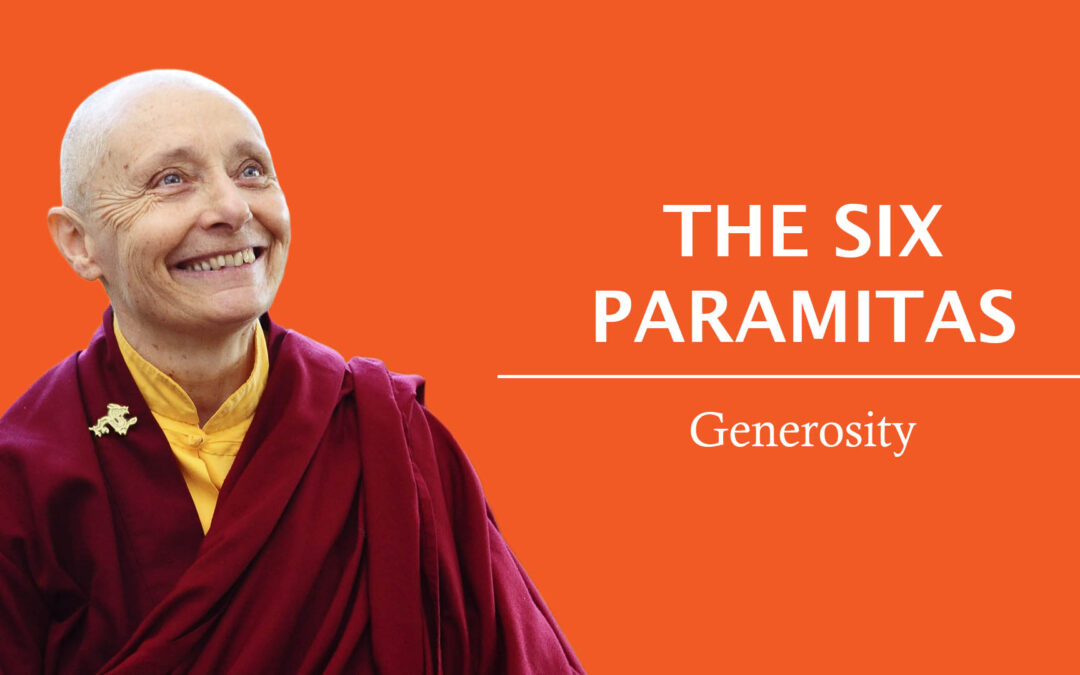
The Six Paramitas: Dana or Generosity
I think the Buddha put dana— which means giving or generosity– at the very beginning, because it is something that we all can do. However deluded we may be, however angry we may be, however jealous or greedy we may be, we can still give. It’s a very basic quality. We don’t need any spiritual heights to learn how to give. Giving means to open up the hands and heart. It’s a very beautiful way to respond to others.
In Asia, people understand very well this whole quality of open-hearted giving and generosity. It is based on the understanding that if we want to be prosperous and successful not only now, but in our future lives, then we have to plant seeds; we are not going to get a harvest if we don’t plant seeds. The seeds for prosperity are generosity and giving. Therefore, if one wants to have success and hopes for things to go well in the way we want them to go, one has to create the causes for that. It is considered that if we have a hard time getting money, if we are always ending up very poor, it’s because we haven’t created enough causes through open-heartedness and generosity in the past. The Buddha one time said that if people understood the true future benefits of giving, then they would not keep even one meal to themselves, but they would try to share it with others. But because we don’t see future results, our minds keep thinking, “If I give something away, then what will I have? What will there be left for me?” That kind of mind not only cuts off our generous impulses, it also creates the causes for not being prosperous later. It’s this whole idea of sharing.
When I was in London one time, I became friendly with a group of Western Sufis who had a sheik or master in Morocco. One of the couples in the group had a son who was about four years old. At one point when I was there, they gave him a box of sweets. Then they said to him, “Now, you should offer one to Anila.” He grasped them tightly to his chest and said, “No, they’re mine.” His father replied, “Yes, of course they are yours, that’s why you can share them with others.” The little boy thought about that one. He was only four. Then his whole demeanour relaxed and he had this big smile. He opened up the box and he went around the room offering his sweets to everyone with such joy. Because we have – that’s why we can share with others. Isn’t that wonderful?. That’s what we are talking about, this quality of giving.
It’s a joy to give. It benefits not only the recipient but ourselves. It benefits us more than it benefits the recipient because it is this close-mindedness of ‘this is me, this is mine and I am not giving to anyone else’ which causes us so much inner pain and prevents us, even if we have so much, from really appreciating it because we are afraid to open-heartedly share with others. We are only afraid that people will try to take things away from us. You see, it isn’t the things which we own which are the problem; it’s our clinging and our grasping which is the problem. It’s that grasping mind. That’s the problem.
So the thing is, do the things own us, or do we own them? Are we able to hold things lightly so that when we see someone in need or just out of appreciation, we can give.
In India, I had a friend who was a Hindu swami, and he lived in a very simple ashram not so far from where we stay. He was actually a direct disciple of a great Indian sage called Ramana Maharshi who is from South India. Our swami had many disciples from all over the place – from Kashmir, from Punjab and Indians who live abroad. But he lived very simply. People were always bringing him things from abroad which are very appreciated in India because usually they don’t have these sort of things. But when anybody gave him anything, no matter what it was, his first thought was, “Who would be a good person for me to give this to?” Nothing stuck. Nothing stuck to his fingers. They slid off into somebody else’s lap, whatever he was holding. And so he was very happy. He was happy because his life was continual receiving and handing over, – not accumulating, not having to carry the heavy burden on his back of all his possessions and his fears of losing his possessions.
I am not saying that you should go home and clear out all your things– that is not the point. The point is this question of opening the heart, of really being able to rejoice in giving to others – not just material things. Material things are good things to start with but we can also give other things like our time, our sympathy, being there when others need us, giving fearlessness.
In Buddhist parlance, there are three kinds of giving that come to my mind. First is the giving of material gifts. Second is the gift of the Dharma. That means being there for others, listening to them, trying to help them, giving them advice, just trying to help people to try to clarify their minds a little bit. But there is also the gift of fearlessness, of being a protection, of helping people to discover their own inner courage – to give that to someone is considered a very priceless gift. So we can start in simple ways. We can start by just developing this quality of being conscious of others, of other’s needs, and of giving joy and pleasure to others. We give with the intention to give delight and to give help if necessary. Not just giving at Christmas or birthdays, or when we are visiting or whatever, but spontaneously. We see something we like and we give it to somebody, maybe even to somebody whom we don’t like. It’s nice to give to people we like, but it’s also nice to give to people whom we don’t like because it’s a beautiful way to relate to others. And it’s a perfection. It’s the first step in the spiritual path so it’s very important. The Buddha put it in front– the quality of joy in giving to others, not always thinking what can I get for me.
Now, traditionally there were 3 different recipients of giving which were recommended. First, to offer to those whom one regards in some way as worthy of gifts. That means, in Buddhist parlance, the Buddhas and Bodhisattvas. It means the monastic Sangha, it means one’s spiritual teacher or any teacher whom one regards as an inspiration and spiritual superior. We offer out of honour and respect.
Then, the second group are those to whom we give because of our gratitude and that means our parents particularly, our teachers and anyone who has helped us in anyway. We are grateful. This quality of honour, gratitude and respect has become so denigrated in our present world. That is one of the reasons why our society is disintegrating — because we don’t inculcate in our children these qualities of the heart: to honour and respect those who are superior to us and to have genuine gratitude and appreciation to all those who have helped us.
So some children abuse and badmouth their parents. But without their parents, they would not be here. They didn’t ask to be here, but their human birth depends on their parents. Without their parents, nothing. When they were born, their parents looked at them and did not say, “Yuk, what a horrible pink worm!” and threw them away outside. Well, their parents cleaned them, they changed their baby’s nappies, they fed them, they soothed them when they cried; their parents were always there for them when they were small. Without our parents, forget it! We wouldn’t be alive today, and it doesn’t matter how hopeless we might think our parents are or not. They are just human beings like everyone else. They have their good points and they have their failings. Who does not? But without them and without their care and attention especially in our very early years, we would not be here. So we owe them an immense depth of gratitude. They fed and cleaned and sheltered us. It’s not like we were so fascinating! Our conversation left something to be desired and children, as we all know, can be very difficult and demanding. But our parents were there and they loved us.
And then our teachers — we wouldn’t be able to read and write or know anything if it were not for these people who taught us, who showed us how to read, how to write, how to think, how to learn. We should be so grateful. We should really appreciate and thank them from our hearts for what they gave us. Why are we critical? Society is very difficult especially with the young nowadays. It has become very demanding, judgmental, critical and selfish. There is little gratitude.
And then the third cycle of people particularly worthy of our giving and help are those deserving on the account of their needs. That means the poor and the sick or anyone who is especially needy. I mean, it’s nice to give your coat to your best friend, but it’s more meaningful to give it to someone who doesn’t have a coat and is cold. Our friend probably has a dozen coats already. This is all very basic – to give to those who really are in need, what is appropriate for them, what they do need. Sometimes, what people need is just attention. What they need is someone to listen to them, to hear their pain, not just dismiss it. Generosity comes at the beginning and it’s important in our lives – the quality of our lives, whether we are close hearted or whether we are open-hearted depends on us. The first gesture of an open-heart is the sense of generosity and giving.
***
May All Beings Benefit
Sarva Mangalam